
Monday, September 27, 2010

Saturday, June 26, 2010
Friday, March 12, 2010
Boston Diary
My flight to Boston had a layover at the The Reagan National Airport just off Washington, D.C. The airport is well-located, as you can see the Washington Monument and the U.S. Capitol from the airport.

Washington is still enamored by the Obamas, as seen by the slew of books on display at the airport book store.

The Church of Scientology was right opposite Srivathsan's apartment.
 Charles River is beautiful and serves as some sort of a boundary between Boston and Cambridge.


(L: Cambridge skyline as seen from the Boston side of the river, and R: Boston skyline as seen from the Cambridge side of the river)
The Quincy Bay reminded me of the Santhome Beach:
 Next up, the Bunker Hill Monument:


The day was capped off with a visit to the Charlestown Navy Yard where the USS Constitution is stationed.


Cambridge is a very bike-friendly city, as can be seen with the bike lanes that sometimes move from the road to the walkway.


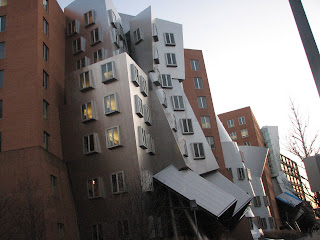
The big attraction on my way back home from the conference venue was MIT's Stata Center.

Also on the way was the Broad Institute, a genomics center affiliated with MIT and Harvard. They had quite a few computer screens facing the outside, which showed some cool genetic screening and sequencing work.


And finally, I saw this on Hanover Street, also called Little Italy. Apparently, Massachusetts is having fun with its newly elected Senator.

Here's a slideshow with some more photos:


Washington is still enamored by the Obamas, as seen by the slew of books on display at the airport book store.


The Church of Scientology was right opposite Srivathsan's apartment.
 Charles River is beautiful and serves as some sort of a boundary between Boston and Cambridge.


(L: Cambridge skyline as seen from the Boston side of the river, and R: Boston skyline as seen from the Cambridge side of the river)
The Quincy Bay reminded me of the Santhome Beach:
 Next up, the Bunker Hill Monument:


The day was capped off with a visit to the Charlestown Navy Yard where the USS Constitution is stationed.


Cambridge is a very bike-friendly city, as can be seen with the bike lanes that sometimes move from the road to the walkway.


The big attraction on my way back home from the conference venue was MIT's Stata Center.


Also on the way was the Broad Institute, a genomics center affiliated with MIT and Harvard. They had quite a few computer screens facing the outside, which showed some cool genetic screening and sequencing work.


And finally, I saw this on Hanover Street, also called Little Italy. Apparently, Massachusetts is having fun with its newly elected Senator.

Here's a slideshow with some more photos:
Reflections from the Boston conference


(L: Kendall/MIT Station on the Red Line and R: Kendall Square as seen from the Marriott Hotel, the venue of the conference)
I got back from Boston 2 days ago where I attended the Water Environment Federation's Urban River Restoration Conference, and wanted to write this down before my memories fade away. I will write a few things about Boston in my next blog entry, hopefully with some pictures, but for now, some observations and incidents from the conference:
1. Elected officials can be sensible: The plenary session at the conference was followed by a panel discussion involving the co-chairs of the conference and some invited guests. Prominent among them was Ms. Henrietta Davis, Vice-Mayor of Cambridge, MA - a city in the Greater Boston area that borders Boston along the Charles River. I found her quite knowledgeable in the area of city planning and waterfront development, topics that were the theme of the conference. The interesting thing is that she is not appointed by someone to this post, based on any expertise in this area. Instead, she is an elected official who has to give campaign speeches and participate in public forums/debates to retain her job. The fact that her constituency includes two of the finest internationally-recognized institutions - Harvard University and the Massachusetts Institute of Technology is only a small consolation. The city is economically and racially diverse, just like any metro city (if you think getting elected to the city council is easy, think Harvey Milk). I found her making sensible arguments and providing cogent responses, and not giving cliched talking points and campaign statements. She seemed to have traveled to other cities and attended other conferences in the 'Green Development' area. If she stands for re-election anytime, consider this an endorsement from me.
2. Not Indian anymore: I met a professor from Canada, who teaches at Queen's University and works on onsite wastewater treatment, the same topic that I work on broadly. We got talking about our mutual works, and I explained to him the state of onsite systems in Ohio and my proposed project, where I happened to mention the term 'health impacts', as it connected to my study. He then replied, "....and you know, healthcare is a big issue in *your* country." Hmmm... so he meant the U.S. by 'your' country. Interesting..!
3. You don't have a card?: I also met the North American director of the International Water Association and got into a conversation. She said her office likes to maintain contacts with universities and wanted to have my card. I replied that I am a student, assuming that she will understand what I meant (that I didn't have a card). Just when she was handing me her card, she noticed that I was not making any effort to take out a card (that didn't exist) and remarked, "..so you really don't have a card". I was definitely surprised, since I didn't expect that people would expect a visiting card from me, in spite of being a student. So, a lesson for those going to conferences - create your visiting card (hand-made/printed/whatever), so you can give your contact information to those who may want to contact you (in case they really want to!).
Monday, January 25, 2010
Monday, January 18, 2010
Enrollment Statistics
I conducted a student survey on "perceptions regarding water and wastewater issues on OSU campus" in November 2009. I got working on analyzing the data. But before I could go too far, I needed to know some details on the demographic make-up of the student body at The Ohio State University, so I could compare my population demography with that of my survey sample.
Here is some interesting information about the demographic composition of OSU students in Columbus campus.
* Male: Female ratio - 51.86: 48.14
* Domestic: International - 92:8
* Ohio: Other states - 85.62: 14.38
* Undergraduate: Graduate: Professional - 75: 19: 6
Now, some information on enrollment by academic break-up:
The most popular major on campus (by numbers): hmmm....Computer Science? Philosophy? Biology? .....The answer is Exploration (in other words, Undecided) with 2816 students. At least, it is better than ending up in the wrong major.
Not accounting for undecided students and the 391 who are part of the Undergraduate Student Academic Services, I have divided the rest (includes undergraduate, graduate and professional students) into 17 colleges. Here's how they match-up against each other (click on the image get high-res view):

Engineering is the most popular field, no surprises there, with 7843 students. But I was surprised to see that the College of Social and Behavioral Sciences has the second-most number of students on campus (7416). In fact, if you separate Architecture (788 students) from Engineering, there are more social scientists studying on campus than engineers! College of Business comes in third with 6540 students, while the next big college is that of Education and Human Ecology (5706 students). The smallest colleges are that of Public Health and Nursing with about 270 students enrolled in each.
China sends the largest set of international students to Ohio State, with 1411 students, followed by Republic of Korea (read South Korea) and India, with about 700 students each. The number of Chinese students jumped 44% compared to last year, while those from other countries including Korea and India dropped by about 3%. Due to the large jump in the enrollment of Chinese students this year compared to the last, the number of international students on OSU campus went up by 7.7% over last year.
Finally, I noticed that there is one international student from Haiti. I hope his/her family and relatives are safe after the massive earthquake. If you are interested in more information, please open this pdf file from the Registrar's website. Information for each Quarter is available here.
Thursday, January 07, 2010
In Print
My second journal article is in print. Click here if you are using a university computer/connection, or click here to view the pdf version.

Citation: S. Vedachalam, J. P. Schmiedeler, K. M. Mancl. 2009. Automation of Delivery Device for Chlorine Dioxide Disinfection. Applied Engineering in Agriculture. 25(6): 915-921.
Wednesday, January 06, 2010
Consumer Surplus
More than 3 months ago, I had posted about the quirky way in which my paper got accepted at a conference. Click here to revisit history. At that time, it wasn't decided if I would go and present at the conference.
It's now decided and sealed. I am going to Boston in March to present at the Urban River Restoration Conference. I talked to my project guide in December, and he indicated that there were $500 left in the project account and I could use that amount to fund my travel. In effect, there was a willingness to pay upto $500 for the travel expense.
That's when I discovered Bing Travel. You may hate Microsoft for whatever reasons, but you've got to love Bing Travel. It is the only website to offer predictions on the best time to purchase tickets. Based on historical records, it gives you a simple indicator of whether fares will go up or down in the next few days and what is your best course of action (buy tickets now/wait). I tried it, waited for more than a week, but got what I wanted - cheap fares to Boston.
I bought my tickets today for $283. Assuming that I spend $50 for checking in a bag, I still spend $333 for travel from the project account. This means that Consumer Surplus for the project account is $500 - $333 = $167. This surplus can now be used for some other project-related expense in the future. Consumer surplus is an important concept in economics and I will let you read more about it on Wikipedia.
Wednesday, December 16, 2009
This time, paper rejection
I received this in my mail (postal mail, not email) a few days ago from the American Water Works Association (AWWA):
Dear Mr. Vedachalam:
Thank you for submitting your abstract entitled (sic) "Designing an Automated Delivery Device for Chlorine Dioxide Disinfection" to the International Symposium on Waterborne Pathogens Planning Committee for consideration for a presentation at the 2010 symposium.
On behalf of the technical committee, I'm sorry to inform you that your abstract was not chosen for a technical session. The planning committee reviews all the submitted abstracts, taking into consideration the timeliness of the abstract topic, the number of abstracts submitted on a specific topic, and the limitation on the number of sessions.
...
And the letter talks about how my abstract was good, but didn't have a place in the program, yada, yada. I am sad, not for getting this paper rejected, but because I missed a chance to visit Manhattan Beach, California, the venue of the symposium. If you didn't know, the median price of a single family dwelling with an ocean view is close to 2.1 million dollars in that town. Wow!
Sunday, November 29, 2009
Proposal Talk
I gave a proposal talk at my program (Environmental Science Graduate Program) seminar couple of weeks ago. The talk was recorded (audio + Powerpoint slides). Click here to view the streaming presentation.
Wednesday, November 18, 2009
Michigan Week
The annual Michigan Week is back. ESPN's Adam Rittenberg has this to stay about Ohio State football coach Jim 'Vest' Tressel:

AP Photo/Jay LaPrete
Ohio State coach Jim Tressel is going for his sixth straight win against rival Michigan.
Jim Tressel may go on to win another national championship at Ohio State.Read the rest of the article here. I think the part about the 'sweater vest manufacturing company' is really funny. But one thing is true: when it comes to Michigan, 'Vest' knows best.
He'll likely win more BCS bowl games and more Big Ten titles. When he's finished coaching, he might enter politics or open his own sweater vest manufacturing company.
But when we look back on Tressel's place in college football history, he will always be remembered for this week. Michigan week.
No one does it better.
Tuesday, October 13, 2009
Monday, September 28, 2009

Friday, September 25, 2009
Conference Presentation
From the inbox:
Dear Sir or Madam,
Congratulations! The following papers have been accepted for presentation during Session 11 of Urban River Restoration 2010 which will be held in March 2010.
Session 11 Creating and Measuring the Value of Urban Rivers
Tuesday, March 8, 2010
1:30pm - 5:00pm
11D 3:30pm Non-Market Valuation of Water Quality Along the Ohio River
Sridhar Vedachalam, The Ohio State University
1 Course Project + Summer Independent Study = 1 Conference Presentation. Wow!
It is not yet decided if we will go ahead and present.
Friday, September 18, 2009
SNL uncovers the truth behind "You Lie"
Monday, August 24, 2009
Mary Jo Kilroy is not so clear on that one
Not only did Mary Jo Kilroy (D-OH-15), my local Congresswoman, took a long time to send her response to my email, she does not use the term "public option", in spite of the fact that I commended her for supporting it in her public statements. Here is the complete text of her email:
Thank you for contacting me about health care reform. I appreciate hearing from you.
The cost of health care is one of the most pressing issues in our country and that is why it is at the top of my agenda for this year. Health care needs a uniquely American solution to the challenges of cost, quality and accessibility. Reform must include the choice and freedom that Americans with health care have come to expect. The most important change I hope most Americans will see is the cost of health care expenses going down.
Americans need quality health care that is affordable and accessible and also guaranteed. Health care is vital to our economic recovery and reducing our long term spending. Businesses are paying too much for health care and all of us pay the "hidden tax" of the uninsured. Moving our country forward will depend upon reducing the cost and increasing the choices in health care. I hope to work with my colleagues, both Democrats and Republicans, to craft this reform.
Thank you again for taking the time to reach out to me. Please contact me if I can be of further assistance.
The email is at best, vague, and meant for a middle-of-the-line independent/centrist voter. I have a feeling that many of the elected officials are mis-calculating the support for the public option, and may pay for it dearly in the next elections, a la Al Gore in 2000.
Wednesday, August 19, 2009
Sen. Sherrod Brown reiterates support for the public option
In a response to my email, U.S. Senator Sherrod Brown (D-Ohio) states (only part of the email reproduced) :
It's great to have such folks in the U.S. Senate!
Since first coming to Congress in 1993, I have refused to enroll in the coverage offered to members of Congress until every American has access to high-quality, affordable health insurance. Should a health care reform bill pass that offers a public insurance option, I would be pleased to enroll.
I strongly believe that our health care system is in need of reform. First and foremost, we must reduce the long-term growth of health care costs for patients, taxpayers, and businesses; protect families from bankruptcy or debt because of health expenditures; guarantee a choice of doctors and health plans; invest in prevention and wellness; improve patient safety and quality of care; assure affordable, quality health coverage for all Americans; and end barriers to coverage for people with pre-existing conditions.
What the insurance industry needs is some healthy competition from a public insurance option. This option would not replace employer-sponsored coverage and no one would be forced into it; the public option would simply give uninsured or underinsured Americans the choice of enrolling in an insurance plan that does not engage in the same cost-avoidance tactics as private insurance plans do. The public health insurance option would also be a vehicle for improvements in quality, coverage, and provider-access that sets the bar higher for private insurance plans. This option would be available to all Americans: both private and government employees, including members of Congress and their staffs.
It's great to have such folks in the U.S. Senate!
Wednesday, August 05, 2009
Paper acceptance
From the inbox:
31-Jul-2009
Dear Mr. Sridhar Vedachalam:
I am pleased to advise you that your revised manuscript SW-07966-2009.R1 "Automation of Delivery Device for Chlorine Dioxide Disinfection" is accepted for publication in Applied Engineering in Agriculture. The most recent files you submitted (uploaded) will be used.
Thank you for your contribution to the literature of the profession.
Monday, July 27, 2009
Living Sustainably (and bigger)
Is that even possible? It may not be entirely possible, but give our current state of affairs, we could at least evaluate ourselves to see which set of people are living most sustainably relative to others. The Natural Resources Defense Council (NRDC), a reputed non-profit environmental group, rated large, medium and small cities based on a sustainability index. Their scoring/ranking criteria is explained below:
We sought the advice of academic, non-profit and government experts to come up with a broad set of criteria by which to measure and compare sustainability efforts in cities across the U.S. The ranking scheme, developed with the help of a scholar from Yale’s School of Forestry and Environmental Studies, was intended as a tool for identifying, for the purpose of spotlighting, those cities that are taking the lead in addressing the major environmental challenges of our time, from global warming to clean air and water.
The cities were evaluated based on air quality, energy production and conservation, recycling, transportation, water quality, etc. More details on the criteria are provided here.
The Top 15 large cities list is dominated by the West - 9 cities, with 6 from California. Seattle, WA tops the list, followed by San Francisco, CA and Portland, OR. 2 cities from the Northeast, Boston and New York as do the two Texas cities - Austin and Dallas. Finally, two cities from the Midwest complete the list - Chicago, IL and Columbus, OH. Wow... Columbus makes it to the top 15 large sustainable cities in the US...at the 15th spot! See the rankings here:
http://smartercities.nrdc.org/rankings/large
Except for the Texas cities, no other city from the South makes it to the Top 15. Louisville, KY takes the 21st spot, making it the only southern city to feature in the Top 30. Well, Louisville is just a few miles away from Cincinnati, so it does not represent a typical city from the South.
Madison, WI tops the list for medium cities, followed by Santa Rosa, CA and Fort Collins, CO (again from the West). Another Western city captures the top spot for small cities - Bellingham, WA.
The profile on Columbus claims that the city and the Mayor are working towards expanding the bike routes in the city to make Columbus the "biking capital" of the country by 2012.
http://smartercities.nrdc.org/cities/columbus-oh
We sought the advice of academic, non-profit and government experts to come up with a broad set of criteria by which to measure and compare sustainability efforts in cities across the U.S. The ranking scheme, developed with the help of a scholar from Yale’s School of Forestry and Environmental Studies, was intended as a tool for identifying, for the purpose of spotlighting, those cities that are taking the lead in addressing the major environmental challenges of our time, from global warming to clean air and water.
The cities were evaluated based on air quality, energy production and conservation, recycling, transportation, water quality, etc. More details on the criteria are provided here.
The Top 15 large cities list is dominated by the West - 9 cities, with 6 from California. Seattle, WA tops the list, followed by San Francisco, CA and Portland, OR. 2 cities from the Northeast, Boston and New York as do the two Texas cities - Austin and Dallas. Finally, two cities from the Midwest complete the list - Chicago, IL and Columbus, OH. Wow... Columbus makes it to the top 15 large sustainable cities in the US...at the 15th spot! See the rankings here:
http://smartercities.nrdc.org/
Except for the Texas cities, no other city from the South makes it to the Top 15. Louisville, KY takes the 21st spot, making it the only southern city to feature in the Top 30. Well, Louisville is just a few miles away from Cincinnati, so it does not represent a typical city from the South.
Madison, WI tops the list for medium cities, followed by Santa Rosa, CA and Fort Collins, CO (again from the West). Another Western city captures the top spot for small cities - Bellingham, WA.
The profile on Columbus claims that the city and the Mayor are working towards expanding the bike routes in the city to make Columbus the "biking capital" of the country by 2012.
http://smartercities.nrdc.org/
Thursday, July 23, 2009
Healthcare quotes
Quotes from today's web on Obama's healthcare plans:
Karl Rove writes in the nation's trusted newspaper, WSJ (see my earlier post):
On Tuesday, Gallup showed Mr. Obama’s personal approval was 55%, down from more than 60% a few weeks ago and lower than the 56% George W. Bush had at this point in his first term.
Didn’t know 1% made all that difference. I guess he didn't get to take a Statistics course, before dropping out of college...twice!
Betsy McCaughey using the same mouthpiece:
Since Medicare was established in 1965, access to care has enabled older Americans to avoid becoming disabled and to travel and live independently instead of languishing in nursing homes….. Medicare has made living to a ripe old age a good value. ObamaCare will undo that.
So, Medicare is good, in spite of being run by the....government, while insurance run by the same government can wreak havoc.
Intershame frames the debate quite well:
Complaining that a inherently socialist concept like insurance - the collection of funds by many to redistribute to the needy - will somehow be more socialist if the government gets involved is laughable.
while Gail Collins at The New York Times blames Sen. Max Baucus (D-MT):
Meanwhile in the Senate, everyone is waiting on Max Baucus of Montana. Nothing is going to happen on health care without the approval of Baucus, whose vast authority stems from the fact that he speaks for both the Senate Finance Committee and a state that contains three-tenths of one percent of the country’s population (emphasis mine).
Subscribe to:
Posts (Atom)
